
Live cricket matches, upcoming fixtures and results
Australia tour of South Africa
Stumps2nd Test1:30 PM, 18 Oct 2026·St George's Park
 SA20/2(12.2)[0-1]Aus2.38 - 2.4
 AusYet to bat
 16°C Light drizzleAus opt to Bowl
Ranji Trophy
StumpsPlate Group8:30 AM, 18 Oct 2026·Meghalaya Cricket Association Cricket Ground
 MEGHA325/6(82)[0-0]
 MnprYet to bat
 18°C SunnyDay 1 - Manipur chose to field.
Ranji Trophy
StumpsPlate Group8:30 AM, 18 Oct 2026·Nagaland Cricket Stadium, Sovima
 NAGALYet to bat[0-0]
 MIZO331/5(88)
 23°C OvercastDay 1 - Nagaland chose to field.
Ranji Trophy
StumpsElite, Group B8:45 AM, 18 Oct 2026·Barsapara Cricket Stadium, Guwahati
 Assam228/6(86)[0-0]
 TpuraYet to bat
 25°C Smoky hazeDay 1 - Tripura chose to field.
Ranji Trophy
StumpsPlate Group9:30 AM, 18 Oct 2026·Gokulbhai Somabhai Patel Stadium
 ARP121/10(51.4)[0-0]
 Sikm147/1(36)29°C Smoky hazeDay 1 - Sikkim lead by 26 runs.
Ranji Trophy
StumpsElite, Group B9:30 AM, 18 Oct 2026·Maharaja Yadavindra Singh International Cricket Stadium, New Chandigarh
 Pnjb269/4(90)[0-0]
 CgrYet to bat23°C Smoky hazeDay 1 - Punjab chose to bat.
Ranji Trophy
StumpsElite, Group D9:30 AM, 18 Oct 2026·MA Chidambaram Stadium
 TN85/2(27)[0-0]
 UTK134/10(56.2)
 28°C Light rain showerDay 1 - Tamil Nadu trail by 49 runs.
Ranji Trophy
StumpsElite, Group A9:30 AM, 18 Oct 2026·Green Park
 UP202/10(71)[0-0]
 Goa43/0(12)
 28°C Patchy rain nearbyDay 1 - Goa trail by 159 runs.
Ranji Trophy
StumpsElite, Group C9:30 AM, 18 Oct 2026·Greenfield International Stadium
 Ker245/6(85)[0-0]
 OdsaYet to batDay 1 - Odisha chose to field.
Ranji Trophy
StumpsElite, Group A9:30 AM, 18 Oct 2026·Reliance Stadium
 Broda77/3(28)[0-0]
 Bihar166/10(53)29°C Smoky hazeDay 1 - Baroda trail by 89 runs.
Ranji Trophy
StumpsElite, Group C9:30 AM, 18 Oct 2026·Maharashtra Cricket Association Stadium
 Maha85/3(26)[0-0]
 JHK169/10(58.2)27°C SunnyDay 1 - Maharashtra trail by 84 runs.
Ranji Trophy
StumpsElite, Group B9:30 AM, 18 Oct 2026·KSCA Cricket Ground
 Kntka281/8(86)[0-0]
 SauYet to bat23°C OvercastDay 1 - Saurashtra chose to field.
Ranji Trophy
StumpsElite, Group D9:30 AM, 18 Oct 2026·Luhnu Cricket Ground
 HP140/10(39.5)[0-0]
 Mum107/2(36)20°C SunnyDay 1 - Mumbai trail by 33 runs.
Ranji Trophy
StumpsElite, Group A9:30 AM, 18 Oct 2026·Sher-i-Kashmir Stadium
 J & K260/10(82.5)[0-0]
 VidarYet to bat12°C SunnyDay 1 - Vidarbha chose to field.
Ranji Trophy
StumpsElite, Group C9:30 AM, 18 Oct 2026·Palam A Stadium
 SVCS83/5(34)[0-0]
 Beng184/10(54)27°C HazeDay 1 - Services trail by 101 runs.
Ranji Trophy
StumpsElite, Group D9:30 AM, 18 Oct 2026·Sawai Mansingh Stadium
 Raj247/2(70.4)[0-0]
 RlysYet to bat25°C OvercastDay 1 - Rajasthan chose to bat.
Ranji Trophy
StumpsElite, Group B9:30 AM, 18 Oct 2026·Andhra Cricket Assocition Grounds, Mulapadu
 AP9/0(2)[0-0]
.png&w=64&q=75 "Hyderabad (India)") Hyd275/10(86)27°C SunnyDay 1 - Andhra trail by 266 runs.
Hyd275/10(86)27°C SunnyDay 1 - Andhra trail by 266 runs.Ranji Trophy
StumpsElite, Group D9:30 AM, 18 Oct 2026·CH Bansi Lal Cricket Stadium
 Hryna139/4(44)[0-0]
 Chd103/10(41.3)26°C SunnyDay 1 - Haryana lead by 36 runs.
Ranji Trophy
StumpsElite, Group A9:30 AM, 18 Oct 2026·Cricket Association Pondicherry Siechem Ground
 PONDI177/10(65.2)[0-0]
 MP23/2(20)27°C OvercastDay 1 - M. Pradesh trail by 154 runs.
Ranji Trophy
LiveElite, Group C9:30 AM, 18 Oct 2026·Palam B Stadium
 Delhi381/4(84)[0-0]
 GujYet to bat
 15°C OvercastDay 1 - Delhi chose to bat.
Sheffield Shield
Upcoming4th Match5:00 AM, 19 Oct 2026·Bellerive Oval
 Tasmania[0-0]Tas2.32 - 4.1
 Victoria22°C Sunny5:00 AM, 19 Oct 2026
Sheffield Shield
Upcoming5th Match5:30 AM, 19 Oct 2026·Adelaide Oval
 South Australia[0-0]SAust1.7 - 9.8
 Queensland21°C Overcast5:30 AM, 19 Oct 2026
Sheffield Shield
Upcoming6th Match8:00 AM, 19 Oct 2026·W.A.C.A. Ground
 Western Australia[0-0]Draw1.57 - 4.1
 New South Wales
 16°C Cloudy8:00 AM, 19 Oct 2026
President's Trophy Grade-I
Upcoming26th Match10:30 AM, 19 Oct 2026·Shoaib Akhtar Cricket Stadium
 KRL[0-0]
 SNGP23°C Sunny10:30 AM, 19 Oct 2026
President's Trophy Grade-I
Upcoming28th Match10:30 AM, 19 Oct 2026·National Ground
 HHKA[0-0]
 SBP23°C Sunny10:30 AM, 19 Oct 2026
President's Trophy Grade-I
Upcoming25th Match10:30 AM, 19 Oct 2026·Diamond Club Ground
 GHG[0-0]
 O&G DCL23°C Sunny10:30 AM, 19 Oct 2026
President's Trophy Grade-I
Upcoming27th Match10:30 AM, 19 Oct 2026·Lahore City Cricket Association Ground
 PakTV[0-0]MITS25°C Sunny10:30 AM, 19 Oct 2026
Afghanistan Under-19s tour of Oman
Upcoming2nd Youth ODI11:00 AM, 19 Oct 2026·Al Amerat Cricket Ground Oman Cricket (Ministry Turf 2)
 Afg-U19[0-1]Afg-U1967 - 126
 Ban-U19
 29°C Clear11:00 AM, 19 Oct 2026
ICC Men's Cricket World Cup League 2
Upcoming138th Match11:00 AM, 19 Oct 2026·Al Amerat Cricket Ground Oman Cricket (Ministry Turf 1)
 Oman[2-2]Nep49 - 57
 Nepal29°C Clear11:00 AM, 19 Oct 2026
UAE ODI Tri-Series
Upcoming2nd Match5:00 PM, 19 Oct 2026·Zayed Cricket Stadium
 Afghanistan[0-0]Afg41 - 43
 Zimbabwe31°C Clear5:00 PM, 19 Oct 2026
Zimbabwe Women tour of India
Completed2nd T20I7:00 PM, 18 Oct 2026·Shaheed Veer Narayan Singh International Stadium
 Ind W104/1(8.5)[2-0]
 ZIM W102/8(20.0)Ind W won by 9 wickets
President's Trophy Grade-I
Completed22nd Match10:30 AM, 12 Oct 2026·National Ground
 KRL129/10(48.2)227/4(41.4)[1-0]
 PakTV220/10(49.4)132/10(38.1)KRL won by 6 wickets
President's Trophy Grade-I
Completed23rd Match10:30 AM, 12 Oct 2026·Diamond Club Ground
MITS376/10(76.3)98/3(29)[0-0] SBP344/10(97.3)Match drawn
President's Trophy Grade-I
Completed24th Match10:30 AM, 14 Oct 2026·Lahore City Cricket Association Ground
 O&G DCL351/10(108.4)123/2(35)[0-0]
 SNGP329/9(104.4)Match drawn
President's Trophy Grade-I
Completed21st Match10:30 AM, 14 Oct 2026·Rana Naveed Cricket Academy
 GHG417/8d(107.5)8/1(3)[0-0]
 HHKA347/10(80.2)Match drawn
Pakistan ODI Tri-Series
Completed1st Match1:30 PM, 18 Oct 2026·Rawalpindi Cricket Stadium
 Pak305/10(49.5)[1-0]
 SL268/10(48.1)Pak won by 37 runs
New Zealand Women tour of Australia
Completed1st T20I1:45 PM, 18 Oct 2026·North Sydney Oval
 Aus W165/8(18.5)[1-0]
 NZ W162/2(20.0)Aus W won by 2 wickets
World Championship of Legends 2026
Completed20th, Final9:00 PM, 18 Oct 2026·Sharjah Cricket Stadium
 ENG-C159/7(20.0)[0-2]
 WI-C165/1(17.0)WI-C won by 9 wickets

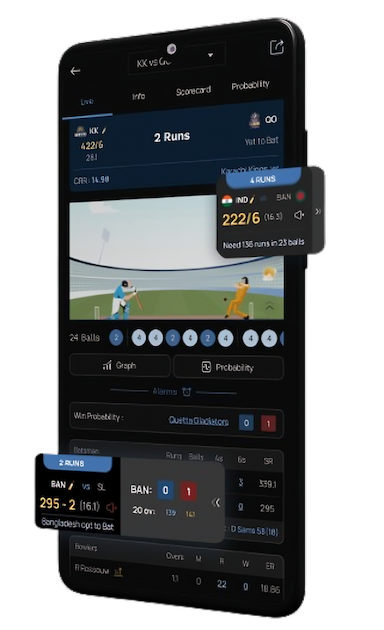
Download the CricRadio app
Never miss any cricket action
Live scores, ball-by-ball commentary and match alerts on your phone.


NEWS
Tilak Varma Opens Up on Giving Up No. 3 Position to Ishan Kishan in T20Is

India batter Tilak Varma has discussed the challenges of moving down the batting order in T20 internationals as Ishan Kishan takes over the No. 3 position. Having regularly batted in the top order, Tilak is now adapting to a finishing role at No. 5 or No. 6 to accommodate India's evolving batting combination.
Following India's fifth T20I against the West Indies in Bengaluru, Tilak acknowledged that adjusting to a different batting position has not been easy. However, he understands the team's requirements and is working towards becoming more effective in the middle and lower order.
The change represents a significant adjustment for the left-hander, whose performances at No. 3 and No. 4 have been an important part of his development in international cricket. With Kishan performing strongly at No. 3, Tilak is preparing to take on a different responsibility for India.
Tilak Varma Admits Moving from No. 3 to No. 5 Is Challenging
Tilak has primarily batted at No. 3 or No. 4 for India in T20Is. However, the team's revised batting combination has pushed him further down the order, requiring him to adapt to the demands of finishing an innings.
Speaking after the fifth T20I against the West Indies, Tilak acknowledged that changing batting positions is a difficult adjustment. He explained that moving from No. 3 to No. 5 or No. 6 requires a different approach, and he has been working on adapting his game accordingly.
Tilak also recognised that Ishan Kishan's current role at No. 3 has influenced his own position. With Kishan performing well in that slot, the Indian batter understands that he must contribute wherever the team needs him.
Although Tilak is more accustomed to facing the new ball and building an innings in the top order, his focus is now on making an impact during the later stages of a T20 match. His ability to adjust could become an important asset for India's middle order.
Ishan Kishan’s Form Changes India’s Batting Combination
Ishan Kishan's performances at No. 3 have strengthened his position in India's T20I batting lineup. His presence in the top order has allowed the team to explore different combinations while giving Tilak the opportunity to develop into a more flexible middle-order batter.
Tilak acknowledged that Kishan has been batting well at No. 3, leaving him with the responsibility of making the No. 5 and No. 6 positions work for the team. Rather than focusing on his preferred position, he is preparing to meet the expectations associated with his new role.
For India, having batters capable of performing in different positions can be valuable in T20 cricket. A flexible lineup allows the team to respond to early wickets, adjust to match situations and maintain scoring momentum during the middle and death overs.
However, finishing an innings requires a different skill set. Batters often have less time to settle in, making it essential to assess conditions quickly, rotate the strike effectively and find boundaries under pressure.
Tilak's ability to adapt to these demands could give India another dependable option in the closing stages of an innings.
Tilak Varma’s Numbers at No. 3 and No. 4
Tilak has produced valuable contributions while batting in the upper middle order. The supplied statistics for his T20I performances since January 2025 show that he scored 304 runs in 11 innings at No. 3, with a strike rate of 125.6.
At No. 4, he accumulated 271 runs in six innings at a strike rate of 120.4. These performances demonstrate his ability to build innings and contribute from different positions in the top and middle order.
His experience in these roles has helped establish him as an important batter in India's T20I setup. However, moving down the order means he must adjust to different match situations.
Instead of regularly having the opportunity to build an innings over several overs, Tilak may need to accelerate almost immediately after arriving at the crease. This will be particularly important when India lose wickets early or need a strong finish after a steady start.
The challenge is to retain the composure and shot selection that have served him well in the top order while becoming more aggressive when required.
Improved Strike Rate Highlights Tilak’s Potential as a Finisher
Tilak's performances lower down the order have shown encouraging signs of his ability to score quickly. According to the supplied statistics for 2026, he has scored 341 runs at No. 5 at a strike rate of 147.6.
His scoring rate has been even more impressive at No. 6, where he has accumulated 185 runs at a strike rate of 201.1. At No. 7, he has scored 23 runs at a strike rate of 209.1.
These figures suggest that Tilak has been able to accelerate his scoring when batting in the lower middle order. His strike rate at No. 6, in particular, highlights the potential value he can offer when India need quick runs during the closing stages.
His ability to contribute from different positions could help India maintain a more balanced batting lineup. Rather than relying exclusively on specialist finishers, the team can benefit from a batter who has experience in the top order but is also learning to deliver under pressure.
Nevertheless, consistency will be important. A successful finisher must combine an aggressive scoring rate with the ability to judge when to take risks and when to preserve wickets for a late surge.
Tilak Varma’s Death-Over Hitting Offers India Another Advantage
Tilak's reported strike rate of 234.31 in the death overs during T20Is in 2026 further underlines his potential in the finishing role. According to the supplied figures, this is the highest among Indian players during that period.
Such scoring ability can be particularly valuable between the 16th and 20th overs, when teams look to maximise their totals. A batter who consistently finds boundaries during this phase can significantly influence the final score.
For Tilak, the key will be to translate that aggressive approach into sustained performances while adjusting to the unpredictability of batting lower down the order. His previous experience at No. 3 and No. 4 provides a foundation, but the finishing role requires him to respond quickly to the demands of each match.
India's decision to use Kishan at No. 3 has created a new challenge for Tilak, but it could also expand his role within the side. If he continues to perform effectively in the middle and death overs, India will have greater flexibility when selecting their T20I batting combination.
For now, Tilak appears prepared to embrace the change and focus on delivering what the team needs. His transition will be worth watching as India continue to refine their lineup and build towards future T20 assignments.
Catch the match live updates, highlights, and full match coverage on CricRadio. Get fast, accurate, and ad-free updates throughout the game. Download the CricRadio app from the Play Store to stay connected. You can also get the live scores of cricket series directly on the CricRadio website for real-time coverage.
#Ishan Kishan
#Tilak Varma
#India